
“You can change the world just by sharing your story.” ― Barack Obama
The Legislature adjourned last week, officially bringing the 2026 legislative session to a close. As always, the end of session brings a mix of emotions for me. I feel proud when our work helps shape the specific language of a bill, relieved when some proposals do not move forward, and frustrated when important issues lack the attention or funding they deserve. This year was especially challenging as the state faced significant fiscal pressures and sharply divided views about how to address the budget shortfall. Education advocates were united in asking for additional K-12 funding and pushing back on unfunded mandates. Throughout the session, I kept your stories in mind and focused on sharing the real experiences of principals, students, and staff as I weighed in on key pieces of legislation. Our advocacy will continue as we look ahead to the 2027 session, working to build the understanding and support our schools need. For now, here is a recap of the 2026 session.
Budget
This year’s supplemental operating budget totals $80.2 billion for the 2025–27 biennium, leaving a projected ending balance of $231 million and about $1.3 billion in reserves. To address the shortfall, legislators relied on a mix of one-time solutions and fund transfers. This includes using $880 million from the Rainy Day Fund—supported in part by excess pension funds from the LEOFF 1 retirement plan—and shifting $394.6 million in capital gains tax revenue from the School Construction Assistance Program account into the state’s general fund.
Among the most significant reductions included in the final supplemental operating budget (SB 5998) for K-12 education are:
- Local Effort Assistance (LEA): reduced by $25.1 million
- School bus depreciation: reduced by $21.1 million
- Transition to Kindergarten: reduced by $27.3 million
- Running Start: reduced by $7 million
- Beginning Educator Support Team (BEST): reduced by $2.3 million
- Next Level Leaders: reduced by $405,000 (cut in half)
The Legislature preserved maintenance-level funding for basic education (an additional $287 million), including a 2.6% COLA for state-funded staff and a 2.6% increase for MSOC (but nothing beyond that, which is still well short of what districts need). Here is a chart that shows salary allocations:
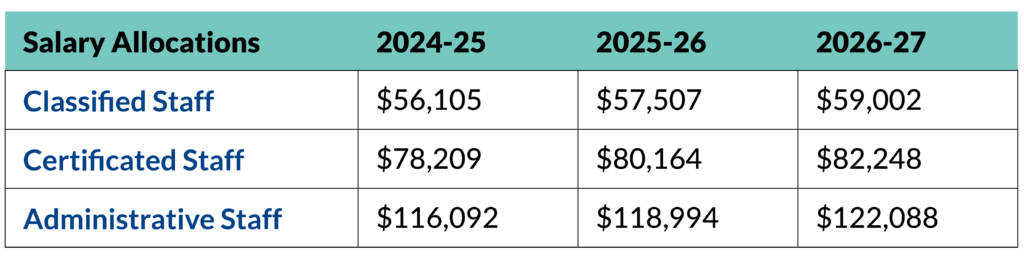
Health benefits will increase from $1,341 per employee per month in the 2025-26 school year to $1,374 per employee per month in the 2026-27 school year.
The final budget also includes targeted investments in several programs that support students and schools, such as:
- $3.5 million for Foster Youth Outcomes
- $1.5 million for Ninth Grade Success
- $1.2 million for Homeless Student Support
- $1.8 million for High School & Beyond Plan implementation
- $2.0 million for Dual Credit fees
And, it’s important to acknowledge that the Legislature did exempt the K-12 system from sales taxes created during the 2025 session by SB 5814. This exemption begins on July 1, 2026 and was passed as part of SB 6346 , otherwise known as the “millionaire’s tax”. Conversations regarding this bill are far from over as legal and political challenges are expected. The K-12 exemption from sales tax includes a “severability clause”, meaning that the exemption remains even if the overarching millionaire’s tax bill is challenged, changed, or repealed.
Speaking of the “millionaire’s tax”, after a historic 25-hour debate on the House floor, the Democrats are celebrating the final passage of Washington’s first income tax. Assuming it survives challenges at the ballot and in court, a 9.9% tax on adjusted gross personal income over $1 million will affect around 20,000 households. Starting in 2029, the tax is projected to generate around $4 billion to:
- Fund free school breakfast and lunch for all K-12 students
- Expand the Working Families Tax Credit to 460,000 more households
- Eliminate sales taxes on diapers, hygiene products, and over the counter medication
- Exempt 60% of businesses from the state B&O tax (up to $300K gross)
Superintendent Chris Reykdal issued this statement that said in part, “The Legislature has not fully funded the state’s paramount duty since 2019, but sadly, they embraced the Governor’s proposed cuts to education. This budget makes harmful reductions to programs that directly serve students—reductions that are likely to impact students identified as low-income the most.”
Senator Nikki Torres (R-Pasco) said in a statement by the Senate Republican Committee , “This supplemental budget grows government again, and the state is already on track for an $878 million deficit by 2028. That tells you everything you need to know. When lawmakers increase spending but still cut programs like Running Start and Transition to Kindergarten, raise copays, and walk away from commitments like public defense funding, the problem isn’t revenue—it’s priorities.”
The capital budget (SB 6003) includes funds for school construction. The Senate Democratsprovided this summary:
“The budget appropriates a total of $109 million for school construction, including $71 million for building modernization and improvement for small school districts and tribal compact schools and $13.9 million for seismic safety upgrades. The budget also structures the small district and tribal compact school modernization program to link current planning grants to future construction grants, so that districts are not left with plans for buildings but no funding to construct them. It also begins a new pilot program to provide school construction assistance funding for school districts with low property values that must run levies and bonds at high property tax values to raise sufficient funds for their building needs, similar to the Local Effort Assistance program, which provides funds for the operating costs of these districts.”
Here is a budget comparison chart that provides additional details for K-12 funding.
The budget decisions made this session reinforce a reality that school districts across Washington already know: the state’s current funding system is not keeping pace with the real cost of educating students. The editorial board at the Seattle Times calls on legislators to “demonstrate a genuine commitment to education”.
Jeff Snell, Executive Director at WASA wrote, “Another legislative session has come and gone. In the postmortems that follow, lawmakers will tout their individual wins. Fully funding K-12 education, the state’s “paramount duty” under the Washington Constitution, will not be among them. The hard truth is it has not been for some time.” Read Jeff’s full editorial here.
While legislators faced difficult budget choices, many districts continue to experience growing structural deficits driven by inadequate funding for basic education obligations such as special education, MSOC, transportation, and staffing. These challenges will not be solved through small adjustments in a supplemental budget. They will require sustained attention, meaningful investment, and a renewed commitment to the state’s constitutional responsibility to fully fund public education. The work ahead—both through legislative advocacy and broader policy discussions—will be critical as we look toward the 2027 session and beyond.
Bills
Here is a look at the K-12 bills that passed this session, with a brief summary of each bill, and a link to my final bill tracking list.
Budget
SB 5998 Supplemental operating budget (Robinson)
SB 6003 Capital budget (Trudeau)
Health/Safety
HB 1634 Providing schools with assistance to coordinate comprehensive behavioral health supports for students (Thai)
- Requires OSPI and the ESDs to develop a technical assistance and training framework to provide school districts and public schools with assistance in supporting student behavioral health.
- Requires OSPI and the ESDs to use the framework to optimize delivery and coordination of behavioral health technical assistance and supports, once it is developed.
HB 1795 Addressing restraint or isolation of students in public schools (Callan)
- Prohibits mechanical restraint, chemical restraint, and physical restraint or physical escort of a student that is life-threatening.
- Specifies that isolation may not be used as a planned behavioral intervention in individualized education programs or 504 plans and allows restraint only under specified circumstances.
- Prohibits the construction, repurposing, or otherwise establishing any new room or other enclosed area for the primary purpose of student isolation.
- Applies student restraint and isolation requirements to all providers of public educational services, except for licensed or certified health professionals of an inpatient health care facility.
HB 2360 Expanding access to albuterol in public and private schools (Donaghy)
- Authorizes public and private schools to maintain and administer school-supplied albuterol in accordance with specified requirements.
- Provides a uniform procedure for administration of school-supplied albuterol, requires parental notification after administration of albuterol, includes employee opt-out provisions, and establishes liability protections.
HB 2429 Supporting children and youth behavioral health (Callan)
- Requires the Governor, subject to the availability of nonstate funding, to maintain an executive coordination officer for the children and youth system of care for the purpose of monitoring the implementation of a strategic plan for children and youth behavioral health.
- Requires the Governor to establish a leadership council to address children and youth health and wellness issues and coordinate efforts to implement the strategic plan.
- Requires certain entities involved in children and youth behavioral health activities to align with the strategic plan and that these activities be implemented in an equitable manner.
- Extends the Children and Youth Behavioral Health Work Group two years, until December 30, 2031 (instead of expiring on December 30, 2029).
SB 5272 Extending penalties for violence at schools and extracurricular activities (Lovick)
- The offenses of Interference by Force or Violence and Intimidation by Threat of Force or Violence are expanded to include an employee or contractor of a public or private elementary or secondary school, an elementary or secondary student, or an official or volunteer acting as an official for extracurricular athletic activities of elementary or secondary students while that person is in the peaceful discharge or conduct of his or her duties.
- Interference by Force or Violence is grounds for a public school student’s emergency removal. If a public school student interferes during extracurricular athletic activities, the student may be excluded from participating in or attending that activity.
- Upon conviction of Interference by Force or Violence, a person, other than a student, must be excluded from entering the school where the crime was committed or from attending the extracurricular athletic activities in which the crime was committed for a period of no less than 12 months and no more than 18 months.
Students
HB 1295 Reading and writing literacy in elementary school (Pollett)
- Requires that when districts update or newly adopt literacy curricula for kindergarten through fourth graders they meet certain specified criteria, beginning in 2027, and that school districts implement these criteria consistent with the curriculum developer’s guidance and school district policies.
- Requires standards for teacher endorsements with literacy-related competencies be revised to include certain elements and requires PESB to direct teacher preparation programs to incorporate revised standards within two years of the revision.
- Directs OSPI to develop and update an educator literacy training program designed to enhance the reading, writing, and spelling skills of kindergarten through fourth grade students, including students displaying indicators of dyslexia.
HB 2534 Promoting educational stability for children of military families (Shavers)
- Makes changes to school district requirements for enrolling children of military families, transferring their education records, and providing them with services and accommodations.
HB 2594 Unhoused children and youth (Reeves)
- Codifies provisions and requirements in state law that align with the federal McKinney-Vento Homeless Assistance Act that are ensuring that homeless children and youths have equal access to the same free, appropriate public education as is provided to other children and youths.
- Provides that the actions of OSPI, school districts, charter schools, and state-tribal education compact schools that meet requirements of the federal act also satisfy equivalent requirements established in state law.
SB 5346 Restricting mobile device usage by public school students. (Liias)
- Revises the definition of digital citizenship so that the norms of appropriate, responsible, and healthy behavior related to current technology use includes student use of mobile devices.
- Directs OSPI to include research on student use of mobile devices and recommended best practice strategies for teaching students how to use their mobile devices responsibly in a web-based location with other digital citizenship and media literacy resources.
- Tasks OSPI with submitting two reports summarizing the policies and procedures that have been adopted limiting student use of mobile devices and any implementation barriers, and to provide evidence-based recommendations related to this topic by December 15, 2028.
High School
SB 5841 Concerning the completion of postsecondary financial aid applications (Boehnke)
- The HSBP platform must: import financial aid application data maintained by the Washington Student Achievement Council to provide an easy way to view the student’s progress on financial aid applications; and provide electronic notifications about eligibility and program requirements to students enrolled in the College Bound Scholarship Program, and those students’ parents or guardians if possible.
- The HSBP must identify whether a student is enrolled in the College Bound Scholarship Program, include evidence that the student has received information about completing financial aid applications, and identify whether the student has completed state or federal financial aid applications.
- The Washington Opportunity Scholarship is added to the list of programs about which students must be informed in their high school and beyond plans.
- Beginning with the 2027-28 school year, financial aid information provided to the student in their HSBP must be reviewed by the student and appropriate staff, to the extent practicable, after the student has indicated completing a postsecondary financial aid application to determine eligibility for financial aid opportunities. The purpose of the review is to determine the student’s eligibility for scholarship programs and completion of related financial aid applications.
SB 5963 Passport to careers program and eligibility for the Washington college grant (Nobles)
- The Passport to Careers Program (PTC) is comprised of the Passport to College and Passport to Apprenticeship grant programs. These programs serve former foster youth and unaccompanied homeless youth. An individual is eligible for financial assistance for up to six years or up to 150 percent of the published length of the student’s program, but the total amount of financial assistance received under both programs may not exceed an equivalent amount that would have been awarded for the individual to attend a public university for six years with the highest annual tuition and state-mandated fees. An individual may not receive assistance under the Passport to College and Passport to Apprenticeship programs concurrently.
- Beginning in the 2026-27 academic year, an individual eligible for PTC qualifies as income-eligible under the Washington College Grant. The definition of financial need in PTC is amended to mean the difference between a student’s cost of attendance and the student’s total student aid index, as determined by the United States Department of Education.
SB 5969 Fulfilling HSBP requirements with IEP transition plans (Cortes)
- The statewide online system for IEPs must be able to integrate a student’s IEP transition plan with the universal online HSBP platform to the greatest extent possible. The HSBP of students with IEPs must be integrated with the statewide online system for IEPs to the greatest extent possible.
Miscellaneous
HB 2557 Providing parental access to special education evaluation reports (Berg)
- Requires a school district to provide a student’s parent or guardian with a copy of the special education evaluation report no later than the 35th school day following receipt of consent to evaluate the student, unless an exception applies or the parent or guardian provides a written waiver.
- Requires the school district to convene a special education eligibility determination meeting no sooner than five school days after the evaluation report is provided and no later than the fortieth school day following receipt of consent.
- Provides that, absent a written waiver, a school district’s failure to provide the evaluation report within the required timeline constitutes a procedural violation.
SB 6278 Concerning the ongoing review of approved teacher and principal preparation programs by PESB (Harris)
- PESB’s ongoing review of fully approved teacher and principal preparation programs must include the following components as established by PESB: program standards; educator role standards; evidence submitted by programs; and input from community constituents, prekindergarten partners, and K-12 partners including classroom educators and district administrators.
- Following a review using these components, PESB will determine a response to any areas of practice where the program’s performance is out of alignment with the standards and requirements, notify the program of the response, and require the program to identify actions it will take to come into alignment.
- PESB must regularly update the components of the ongoing program review to reflect the changing needs of the modern classroom.
Looking Ahead
Looking ahead, the rest of 2026 will be a very active time for our advocacy efforts. Three different K–12 funding workgroups will continue examining the state’s school funding system, and we will want to be involved in these discussions. The K-12 Funding Equity Workgroup is coordinated by OSPI and their work will become part of their decision package request for Governor Ferguson next fall. The second group is the ” UW SUPES ” group (UW Superintendents United in Partnership for Equitable Schools). Their central purpose is to refine their collective vision for establishing an ample and equitable K-12 funding system for all students. The third group is called “The Big Idea” group and it is coordinated by Representative Sharon Tomiko Santos, Chair of the House Education Committee. Rep. Santos has been working with staff from NCSL (the National Conference of State Legislators) to review how other states have been working to create a 21st century system of K-12 education and how that should look in Washington state.
There is also increasing discussion about potential legal action against the state through what many are referring to as a “McCleary 2.0” lawsuit—focused on whether Washington is once again failing to fully meet its constitutional obligation to fund basic education.
In addition, next fall’s elections will be critical, with all House seats and half of the Senate on the ballot. These races will help shape the policy and funding decisions that directly impact our schools. You can find more information on how to get involved through our Political Action Committee . The interim provides valuable opportunities to strengthen relationships—whether that’s meeting with legislators over coffee, sharing your perspective, or supporting candidates who understand and champion our work.
We will also choose a 2026 “Torch of Leadership” Award winner. This annual award honors individuals serving in the Washington state government who have demonstrated outstanding support of principals and the principalship. These award winners are some of our best champions.
And this year, we have convened a statewide Future School Leaders Workgroup to develop recommendations on the policy and funding priorities needed to strengthen the pipeline of effective school leaders. The group’s report will be released later this spring and will help inform a clear, targeted “ask” to OSPI as they develop their decision package for Governor Ferguson’s consideration in building the 2027–29 biennial budget.
Your Voice
Keep telling your stories about what students and educators need to create successful learning environments. Check out the “Important Links” below to find out how to contact your own legislators. They care very much about hearing directly from their constituents. When we weigh in as an association, it is helpful and important, but having many of you reach out directly with a short email to legislators can be much more powerful. Find your legislator and email them here if you have any thoughts to share.
Say “Thank You”
Be sure to thank the elected officials who helped you this session, especially bill sponsors, committee chairs, budget writers, and the Governor. Here are 12 ways to say “thank you”:
- By email
- By snail mail
- On social media
- Ask them for a quote and send a press release
- At a town hall
- In a coalition sign-on letter
- In a letter to the editor or guest column
- At a legislative district meeting
- Give them a “Legislator of the Year Award”
- Ask them to speak at an event
- Send a campaign contribution
- Host a campaign fundraiser for them
We will also continue our monthly emails to legislators as part of our “Principal Partners for Legislators” program as well as coordinating “Principal for a Day” events with legislators this spring and next fall.
If you have questions or comments or want to get involved with future advocacy efforts, please reach out to me. Many thanks for all that you do for students, staff, and our advocacy efforts.