Cherry Blossoms With a Cherry on Top
What an amazing week of advocacy here in our Washington and in the “other” Washington, our nation’s capital. Our 12 principals arrived just in time for peak cherry blossom viewing. What a treat!
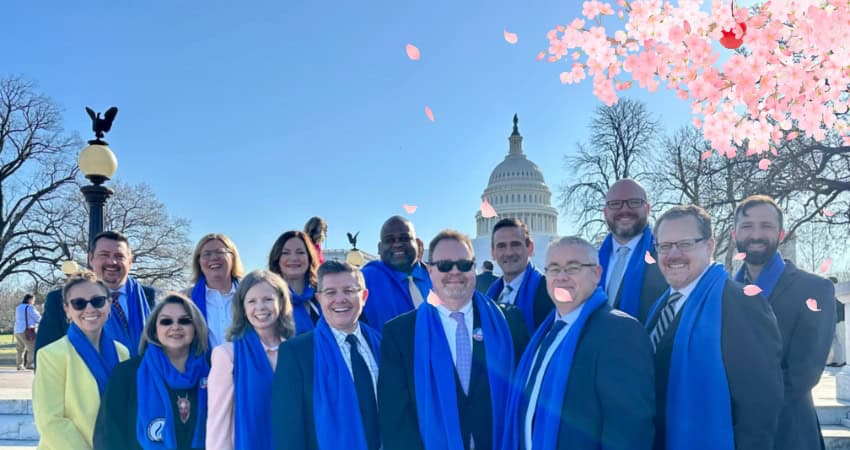
The National School Leaders Advocacy Conference is organized each March by NAESP and NASSP. We spent the first two days learning from expert panels, congressional staff, principals from around the country, and Cindy Marten, Deputy Secretary of the Department
of Education, about various pieces of federal legislation and effective advocacy strategies. On Wednesday, over 400 principals headed to the Capitol to meet with their members of Congress to talk about educator shortages, improving school mental health,
wellness, and safety resources, and various budget priorities. Our group shared poignant stories about students and staff in their buildings related to each area, and we built relationships with decision-makers and principals from other states.
Here in our Washington, the cherry on top for this week was listening to the House Education Committee pass SB 5175 out of their committee
unanimously! An amendment was added to clarify that a superintendent might offer a contract for more than one year when a principal has:
- been employed as a principal for three or more consecutive years;
- been recommended by the superintendent as a candidate for a two or three-year contract because the principal has demonstrated the ability to stabilize instructional practices, and received a comprehensive performance rating of level 3 or above in
their most recent comprehensive performance evaluation; and - met the school district’s requirements for satisfying an updated record check.
We appreciate your messages to legislators encouraging them to support this bill and look forward to watching it pass off the House floor soon.
House Budget
This week, the House released its budget. We knew it would have less funding than the Senate did for key programs like special education and transportation, but there are a few items that the House included that the Senate did not. I’ll look for
a side-by-side comparison of these budgets next week to share with you. In both budgets, legislators would take ESSER funds allocated to OSPI (not to individual districts) and reroute these dollars to programs in this year’s operating budget.
As you can imagine, this is not sitting well with people. Stay tuned for how this might be resolved.
Here are some of the highlights from the House budget:
K-12 Education Increases
K-12 Salaries and Compensation ($593 million 2023-25; $1.67 billion 5-year total)
Salary allocations are increased for inflation as provided in HB 1732 (K-12 inflation adjustments) and rebasing. Budgeted inflation for salaries is 3.7% in the 2023-24 school year (SY) and 3.9% in the 2024-25 SY.
SEBB health benefit rates are increased to $1,116 per employee per month in the 2023-24 SY and $1,178 per employee per month in the 2024-25 SY. These amounts are in addition to the $734 million in 2023-25 and $2.3 billion 5-year for salary inflation at
maintenance level.
Special Education Enhancements ($94 million 2023-25; $67 million Federal 2023- 25; $366 million 5-year total)
Funding is provided to increase excess cost multipliers, raise the funded enrollment limit, support inclusionary practices, and lower the safety net threshold as required under HB 1436 (Special education funding). Funding is also provided for summer evaluations, and extended transition supports.
Free School Meal Expansion ($56.4 million 2023-25; $28.5 million Federal 2023-25; $178 million 5-year total)
Funding is provided to support expanded access to free meals through the federal Community Eligibility Provision pursuant to HB 1878 and HB 1238 (Free school meals).
Dual Credit Enrollment Enhancements ($19.4 million 2023-25; $36.9 million 5-year total)
Funding is provided to increase the Running Start combined maximum enrollment cap from 1.2 FTE to 1.6 FTE.
Transition to Kindergarten ($14.7 million 2023-25; $26.6 million 5-year total)
Funding is provided for the implementation of HB 1550 (Transition to Kindergarten), which creates the Transition to Kindergarten (TTK) program beginning in the 2024-25 school year. Funding is sufficient to support 5,077 FTE students in the TTK program during the 2024-25 school year.
Professional Education Workforce ($12.0 million 2023-25; $31.7 million 5-year total)
Funding is provided for the implementation of HB 1565 (Prof. education workforce), which establishes a teacher residency program and establishes educator workforce data collection and analysis requirements. Funding is sufficient to support five teacher residency cohorts with 17 residents per cohort, beginning in the 2024-25 school year. Additional funding is provided for the Beginning Educator Support Team (BEST) program to increase the number of beginning teachers who receive mentoring support. This funding is important to us because there may be some funds here for additional principal mentors.
Bills That Keep Moving
Here are a few key bills that keep moving. Some are still making their way through fiscal committees and need to pass out of those committees by Tuesday, April 4, the next cut-off day. Some bills don’t have a fiscal impact and are waiting on a vote
by either the House or the Senate.
Both of the special education funding bills are still alive. The Senate bill, SB 5311, would raise the special education cap from 13.5%
to 15% and increase the multiplier at a greater rate than the House. The House version, HB 1436, funds special education at a lower
level.
SB 5174 is the transportation funding bill. This bill was narrowed from its original version and would create
the Transportation Safety Net. Safety net awards would be provided to school districts with a demonstrated need for additional transportation funding for special passengers, as mentioned above.
HB 1550 is the Transition to Kindergarten bill. The current version is much improved, and it would rename Transitional Kindergarten
as the Transition to Kindergarten program, and state that this program is not part of the state’s program of basic education. It directs OSPI to adopt rules for the administration and the allocation of state funding for this program and specifies
minimum requirements for these rules. And it provides a funding formula for the program using certain portions of the prototypical school funding model and requires certain data to be reported. Current TK programs will remain in place for the 2023-24
school year, but changes would come in the following school year.
HB 1658 would authorize high school students to earn up to two elective credits for paid work experience.
If you are interested in small school construction, SB 5126 (common school trust revenue to the small school modernization
program) is still moving, and the Senate Capital budget gets a good review by OSPI for its attention