

Why Reducing School Leadership Harms Students, Staff, and Outcomes in Washington Schools
As your professional membership organization, AWSP is often asked how we can help prevent cuts to school leadership when districts face financial challenges.
While we don’t have the authority to directly influence local staffing decisions, we can support you with clear, research-informed information and practical tools to strengthen your local advocacy. What follows is exactly that.
Any change in administrative support—whether eliminating an assistant principal (AP), splitting an AP across multiple buildings, or converting the role into a dean position—has real consequences. These impacts are often felt first by the individuals in those roles, but the effects don’t stay there. They quickly extend to principals, staff, and ultimately students.
If you need additional support, don’t hesitate to reach out to the AWSP team.
Why This Matters
When districts face budget shortfalls, reducing assistant principal positions can look like a practical solution. The savings appear on this year’s budget. The costs land elsewhere — in next year’s principal turnover, in rising teacher attrition, and in years of student achievement that have to be made up.
A substantial body of research now makes both halves of this equation clear: school leadership is one of the most powerful school-based influences on student learning, and assistant principals are the structural support that holds that leadership capacity together. Cutting AP positions doesn’t trim around the edges of school effectiveness — it removes one of the load-bearing pieces.
In today’s increasingly complex school environments, assistant principals are not expendable — they are essential.
What the Research Says About Assistant Principals
The most rigorous synthesis of AP-specific research to date is the Wallace Foundation’s 2021 report, The Role of Assistant Principals: Evidence and Insights for Advancing School Leadership (Goldring, Rubin & Herrmann, 2021). Three findings from that synthesis are central to any conversation about cutting AP positions:
1. APs deliver the day-to-day leadership functions that erode first when cut.
APs spend a disproportionate share of their time on student discipline, supervision, family communication, and behavior management — exactly the functions schools cannot stop doing when an AP position is eliminated. That work doesn’t disappear; it shifts to principals, who absorb it at the cost of instructional leadership.
2. AP service is the most common pathway into the principalship.
Most principals serve as APs first. Cutting AP positions doesn’t just affect today’s schools — it reduces the principal pipeline at exactly the moment Washington is facing principal shortages and rising principal turnover (Knight et al., 2023). Districts that reduce APs today are reducing their own future principal candidates.
3. Principal effectiveness depends on AP support.
The research is consistent: when principals have adequate AP support, they can focus on the instructional leadership work that drives student outcomes. When that support disappears, principals are pulled into operations, instructional leadership declines, and the school’s improvement trajectory slows.
These findings do not stand alone. They are reinforced by two decades of research on school leadership more broadly — research that decision-makers should understand before reducing leadership capacity.
Why This Matters Even More: What We Know About School Leadership
School leadership is one of the most powerful — and most consistently underestimated — investments in student learning.
Since the foundational Wallace-commissioned review by Leithwood et al. (2004), leadership has been understood as “second only to classroom instruction” in its impact on student learning. More recent research suggests even that estimate was conservative. The 2021 Wallace synthesis (Grissom et al., 2021, p. xiii) found that replacing a below-average principal with an above-average one produces nearly three additional months of math and reading learning per student, per year — multiplied across every student in the school.
“

Gates’s assessment refers to the RAND/Wallace Principal Pipeline Initiative — a multi-year, multi-district evaluation showing that comprehensive investment in principal preparation, hiring, and support produces student achievement gains larger than any other districtwide intervention the researchers could identify (Gates et al., 2019). The assistant principalship is the most common — and most important — step in the pipeline that evidence is built on.
With that context in mind, the consequences of cutting AP positions become measurable in three specific areas.
1. Student safety and supervision are affected
Washington schools are expected to implement comprehensive safety systems, including threat assessment, crisis response, and proactive supervision (OSPI; U.S. Department of Education). These systems depend on having multiple trained administrators available on campus — single-administrator coverage is not viable for serious incidents.
When AP positions are reduced:
- Emergency response capacity is diminished, increasing risk during critical incidents
- Supervision gaps widen during high-risk times (arrival, lunch, passing periods)
- Schools struggle to meet expectations for behavioral threat assessment and prevention protocols
National and state guidance assume a multi-administrator Incident Command structure (U.S. Department of Education, 2013), and behavioral threat assessment best practices require multidisciplinary teams that cannot function with a single administrator on site. This is not a redundancy concern — it’s an operational floor.
Bottom line: Reducing administrative capacity makes it more difficult for schools to meet Washington’s safety expectations.
2. Positive school culture erodes
OSPI prioritizes safe and supportive learning environments built on relationships, belonging, and family engagement. The Goldring et al. (2021) synthesis identifies APs as the frontline leaders for exactly these functions:
- Student behavior systems
- Family communication
- Daily school climate and visibility
When AP positions are cut:
- Student behavior systems become reactive rather than proactive
- Teacher support declines, contributing to burnout and turnover
- Family engagement suffers, particularly in high-need communities
- Leadership visibility decreases, weakening trust and connection
Research from the Learning Policy Institute identifies administrative support as one of the top predictors of teacher retention — teachers who strongly disagree that their administration is supportive have a predicted turnover rate of 23.6%, more than twice the 10.5% rate for teachers who strongly agree they’re well supported (Carver-Thomas & Darling-Hammond, 2017, Figure 22).
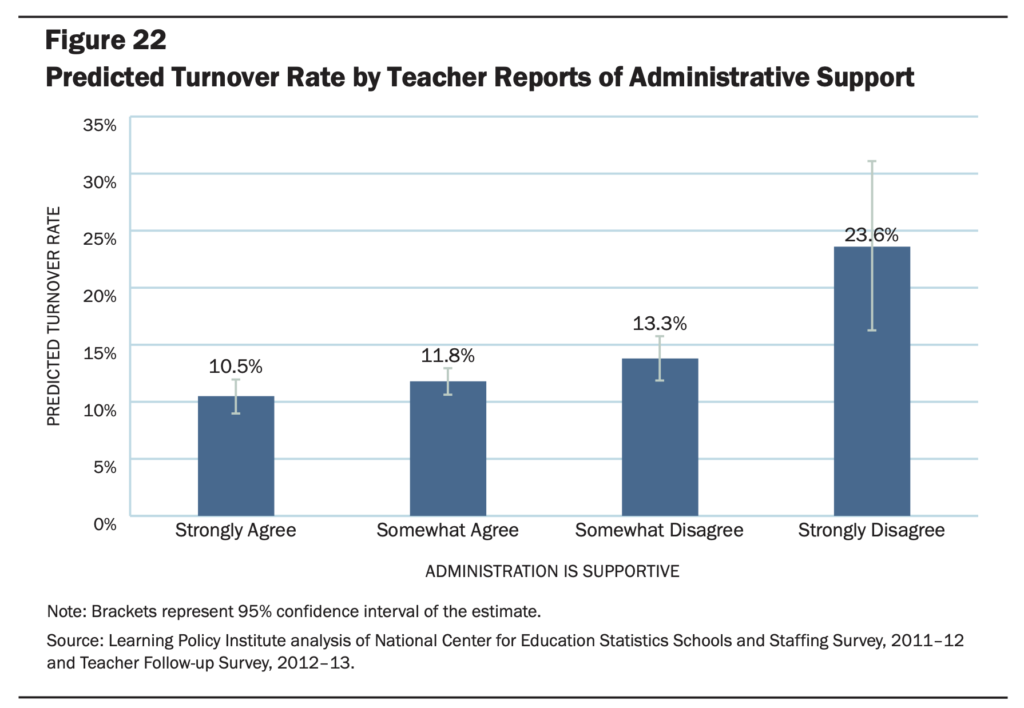
When AP positions are cut, that support thins; when support thins, teachers leave; when teachers leave, student achievement follows.
Bottom line: APs operationalize the conditions OSPI identifies as essential for student success — without them, those conditions erode.
3. Instructional improvement stalls
School improvement efforts — at both the state and federal level — depend on:
- Ongoing classroom observation and feedback
- Data-informed decision-making
- Coordinated intervention systems
These are precisely the functions that disappear first when principals are pulled into operational triage. Assistant principals make instructional leadership possible by expanding capacity to:
- Be present in classrooms
- Support coaching and professional learning
- Coordinate systems like MTSS
When AP positions are reduced:
- Principals are pulled toward operational and compliance responsibilities
- Time for instructional leadership decreases
- Improvement efforts slow or lose momentum
Decades of research, including a 2018 meta-analysis published in the Review of Educational Research (Kraft, Blazar & Hogan), confirm that sustained, job-embedded instructional coaching produces meaningful improvements in teaching and student outcomes — the kind of support that depends on leadership capacity to deliver.
Bottom line: Reducing leadership capacity limits a school’s ability to improve teaching and learning.
The Bigger Impact On Washington Schools
Short-term staffing decisions can create longer-term consequences:
- Increased discipline and safety challenges
- Higher educator turnover
- Greater principal workload and burnout risk
- Reduced student engagement and achievement
It’s also important to recognize that Washington’s current funding model already reflects constrained leadership capacity. The state’s prototypical school funding formula funds administrative staffing at approximately 319 students per administrator, while a recent state workgroup (OSPI, Building Staffing Capacity to Support Student Well-Being. 2021–23 Biennial Operating Budget Decision Package, 2023, p. 6) recommended a ratio closer to 300:1.
In other words, schools are already operating below recommended staffing levels — further reductions move them even farther from what is considered adequate.
Research from the University of Washington (Knight et al., 2023) finds that principal turnover in Washington is rising and disproportionately affects high-need schools — the same schools that can least afford the resulting disruption. National research confirms the pattern: principal turnover is associated with declines in student achievement that take three or more years for a school to recover from (Miller, 2013), and with elevated teacher turnover in the year following a principal’s departure (Béteille, Kalogrides & Loeb, 2012).
Principal turnover also carries a significant financial cost — estimated at approximately $75,000 per principal in recruitment, hiring, and onboarding in 2014 dollars (School Leaders Network, 2014), a figure that has almost certainly grown.
Beyond cost, leadership turnover is associated with:
- Staff instability
- Slower school improvement
- Declines in student outcomes over time
At a time when Washington is investing in student mental health, inclusion, and academic growth, reducing leadership capacity makes it more difficult for schools to deliver on those priorities.
Key Message for Decision-Makers
Assistant principals are not an added expense. They are the infrastructure that makes everything else in a school possible.
Reducing AP positions:
- Constrains safety and supervision capacity
- Weakens school climate and staff retention
- Limits instructional improvement
- Disrupts the principal pipeline Washington depends on
- Increases the risk of costly leadership turnover
When districts invest in school leadership, they strengthen every classroom in the building. Principals and assistant principals create the conditions that allow teachers to teach, students to succeed, and schools to remain safe, stable, and responsive to their communities.
The question is not whether districts can afford assistant principals. It’s whether they can afford the cascading costs of losing them.
References
Béteille, T., Kalogrides, D., & Loeb, S. (2012). Stepping stones: Principal career paths and school outcomes. Social Science Research, 41(4).
Carver-Thomas, D., & Darling-Hammond, L. (2017). Teacher turnover: Why it matters and what we can do about it. Learning Policy Institute.
Gates, S. M. (2019). Investing in principals helps students succeed. RAND Corporation. https://www.rand.org/pubs/articles/2019/investing-in-principals-helps-students-succeed.html.
Goldring, E., Rubin, M., & Herrmann, M. (2021). The role of assistant principals: Evidence and insights for advancing school leadership. The Wallace Foundation.
Grissom, J. A., Egalite, A. J., & Lindsay, C. A. (2021). How principals affect students and schools: A systematic synthesis of two decades of research. The Wallace Foundation.
Knight, D. S., Candelaria, C. A., Sun, M., Almasi, P., Shin, J., DeMatthews, D. (2023). Principal retention and turnover during the COVID-19 era: Do students have equitable access to stable school leadership? University of Washington.
Kraft, M. A., Blazar, D., & Hogan, D. (2018). The effect of teacher coaching on instruction and achievement: A meta-analysis of the causal evidence. Review of Educational Research, 88(4), 547–588.
Leithwood, K., Louis, K. S., Anderson, S., & Wahlstrom, K. (2004). How leadership influences student learning: A review of research for the Learning from Leadership project. The Wallace Foundation.
Miller, A. (2013). Principal turnover and student achievement. Economics of Education Review, 36.
Office of Superintendent of Public Instruction. (n.d.). School Safety Center [Web resource].
Washington State Legislature. (2019). Engrossed Substitute House Bill 1216: Concerning school safety and well-being.
Office of Superintendent of Public Instruction. Building Staffing Capacity to Support Student Well-Being. 2021–23 Biennial Operating Budget Decision Package (DP). (2023, p. 6).
School Leaders Network. (2014). CHURN: The high cost of principal turnover.
U.S. Department of Education. (2013). Guide for developing high-quality school emergency operations plans.