What if the best way to hire a great teacher wasn’t to ask more interview questions, but to actually watch them teach?
That’s the question behind an innovative approach to teacher hiring at Irene Reither Elementary School in the Meridian School District.
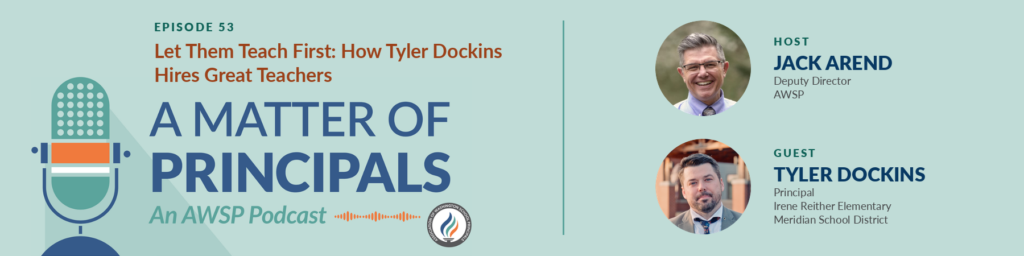
In the latest episode of AWSP’s A Matter of Principals podcast, Deputy Director Jack Arend welcomes Tyler Dockins, principal of Irene Reither Elementary, for a conversation about rethinking traditional hiring practices, building a culture of instructional excellence, and creating systems that help teachers and students thrive.
Throughout the conversation, Tyler challenges school leaders to hire for potential, embrace creativity, and recognize that some of the most important leadership decisions happen long before a teacher enters the classroom.
Building a Culture That Drips From the Walls
Irene Reither Elementary is a big school in a close-knit community.
Serving more than 800 students in pre-K through fifth grade, with over 100 staff members, the school is part of what Tyler affectionately calls the “Meridian magic.”
It’s a community where relationships run deep, students grow up together, and graduating seniors return to walk the hallways of the schools that helped shape them.
But what makes Irene Reither special isn’t simply its size or community connections.
It’s the culture of learning among the adults.
Tyler describes a school where teachers regularly discuss instructional research, share strategies, examine student work, and continually refine their craft.
“The culture of the school drips from the walls,” he explains.
You can see it in how staff members interact, what they talk about, and how they approach the work of teaching and learning.
At Irene Reither, belonging is the basic expectation. But belonging alone isn’t the finish line.
Tyler wants students to develop the academic skills, relationships, and confidence to live what he calls “choice-filled lives.”
And creating that kind of environment starts with the adults who serve students every day.
What If We Actually Watched Teachers Teach?
Like many principals, Tyler had experienced the limitations of traditional hiring.
A panel interviews candidates, asks carefully developed questions, reviews their qualifications, and makes a decision based largely on how well they communicate their experience and philosophy.
Sometimes it works beautifully.
Other times, even after a thoughtful interview process, a new teacher struggles with classroom culture, instructional practices, or the demands of the position.
Those challenges affect everyone.
Students may not receive the learning experience they deserve. Colleagues spend additional time providing support. School leaders redirect attention and resources to help a teacher who may be questioning their own abilities.
Tyler and his team began asking whether they could build a better process.
Their solution was surprisingly straightforward.
If teaching is what candidates will spend most of their time doing, why not make teaching part of the interview?
Today, candidates who advance through Irene Reither’s screening process are invited to teach a short demonstration lesson with actual students.
The lesson isn’t hypothetical.
Candidates receive a grade-level standard and an instructional task informed by the school’s own student assessment data. They know the available materials, the time expectations, and the questions they’ll be asked afterward.
The goal isn’t simply to see whether someone can deliver a polished lesson.
It’s to understand how they think about instruction, connect with students, respond to challenges, and reflect on their practice.
It’s a shift from asking candidates to describe effective teaching to giving them an opportunity to demonstrate it.
“

Hiring for Potential, Not Just Performance
One of the most important principles behind Irene Reither’s approach is Tyler’s belief in hiring for potential.
That philosophy shapes the process from the beginning.
After reviewing applications, the school conducts brief video conversations with a broader pool of candidates than might typically receive a full interview.
The questions are intentionally simple.
What’s your story?
Why Meridian, and why now?
Tyler believes these conversations help the team understand candidates as people, rather than relying exclusively on resumes that may reflect differences in experience, opportunity, and access.
The school looks for two qualities in particular: a genuine love for working with children and an enthusiasm for the craft of teaching.
Candidates who move forward participate in a demonstration lesson, followed by an instructional coaching conversation.
But even before they teach, students play a role.
Student ambassadors welcome candidates and lead tours of the campus, helping them become comfortable in the school environment.
After the demonstration lesson, students are asked what they enjoyed about the experience.
Their feedback becomes the starting point for a coaching conversation in which candidates reflect on what went well, what they might change, and how they would approach the next day’s instruction.
The hiring team also looks at how candidates respond to feedback and whether they take ownership of the instructional decisions within their control.
The process offers something valuable even to candidates who aren’t selected: meaningful feedback from educators who have observed their teaching.
For Tyler, that’s part of honoring the profession.
And for the school, it creates opportunities for staff members to learn from one another while making better-informed hiring decisions.
Turning One Good Idea Into a Better System
Changing a familiar process requires more than a good idea.
It takes collaboration, careful planning, and a willingness to challenge assumptions.
Tyler describes two leadership lessons that emerged from implementing the hiring process: being creative and learning to go slow to go fast.
Rather than simply replacing the traditional interview process without discussion, he invited district leadership to observe the new approach.
The process was designed to be consistent, fair, rigorous, and manageable within the district’s existing resources.
And when the district’s human resources leadership participated, they heard directly from the educators involved about the value of watching candidates teach.
The process also created opportunities beyond hiring.
Instructional coaches, teacher leaders, and aspiring administrators participated in evaluating lessons and discussing effective instruction. Those conversations became professional learning experiences in their own right.
The approach eventually spread beyond Irene Reither.
Meridian’s middle school adopted and adapted the model, including experimenting with demonstration-based hiring for paraeducators.
And the learning moved in both directions.
As colleagues refined the process for their own settings, they generated ideas that could strengthen the original approach.
Tyler describes this as an example of “iron sharpens iron.”
When school leaders share effective practices, they don’t simply help another school.
They create opportunities for their own work to improve.
It’s a reminder that innovation doesn’t have to remain confined to one building, one team, or one leader.
Great Hiring Is a Leadership Framework Story
Although the conversation focuses on teacher hiring, Jack and Tyler continually connect the work to the broader responsibilities of school leadership.
The approach is a particularly strong example of Criterion 6: Managing Resources in the AWSP Leadership Framework.
Hiring is one of the most consequential decisions a principal makes. It involves allocating staff time, developing talent, investing in professional learning, and making decisions that influence a school’s capacity to serve students for years to come.
But the connections don’t stop there.
Criterion 5: Improving Instruction comes to life through demonstration lessons, instructional coaching, and professional conversations about effective teaching.
Criterion 3: Planning with Data is reflected in the use of student assessment results to design authentic instructional tasks for candidates.
And Criterion 1: Creating a Culture is evident throughout the process, from the school’s emphasis on belonging to the trust created through collaborative, transparent hiring decisions.
The same leadership move can influence multiple criteria at once.
That’s an important reminder for principals and assistant principals who sometimes experience the framework primarily through the lens of evaluation.
Effective leadership doesn’t happen in isolated boxes.
A thoughtfully designed system can improve how a school hires, how teachers learn, how leaders collaborate, and ultimately how students experience school.
Build Your Team
Near the end of the conversation, Jack asks Tyler to share one piece of advice for other principals and assistant principals.
His response is immediate:
“Build your team.”
Tyler credits much of the success at Irene Reither to the colleagues who have helped him develop, challenge, and improve his ideas.
He encourages school leaders to surround themselves with people who bring different strengths, offer honest feedback, and make the entire team better.
That requires a willingness to set ego aside.
It also means developing future leaders, building connections with colleagues beyond your own school, and recognizing that the best ideas often emerge through collaboration.
The hiring process at Irene Reither didn’t become successful because one principal had a clever idea.
It grew because a team was willing to question an established practice, design something better, learn from the experience, and share what worked.
And that’s a lesson that extends far beyond teacher hiring.
Listen to the Conversation
From rethinking traditional teacher interviews to building a culture of instructional excellence, Tyler Dockins offers a practical example of what happens when school leaders challenge familiar systems and work together to improve them.
Hear the full conversation with Tyler and AWSP Deputy Director Jack Arend on Episode 53 of A Matter of Principals.
Listen anywhere you get your podcasts.