Welcome to AWSP’s AI Resources Hub, your guide to leveraging AI in school leadership. Here, you’ll find essential tools, frameworks, and prompts to help you integrate AI effectively, from enhancing daily operations to fostering innovative learning environments. Dive in to explore how AI can support strong schools and successful students, equipping you and your team to navigate the future of education with confidence.
Why AI?
AI offers powerful benefits for school leaders, helping to streamline administrative tasks, personalize student learning, and enhance decision-making with data-driven insights. By automating routine tasks, AI frees up principals to focus on building a positive school culture and supporting staff and students.
How Can You Use AI?
Principals can use AI to streamline tasks like scheduling, attendance tracking, and data analysis, saving time and providing actionable insights. AI also supports personalized learning, communication, and proactive interventions, allowing principals to focus more on leadership and student success.
View Our AI Library
AWSP has curated a collection of prompts to best meet your needs as a school leader. Arranged by category, prompts are each to find and practical to implement right away.
OSPI Guidelines
The Washington State Office of Superintendent of Public Instruction (OSPI) has developed comprehensive guidance on integrating artificial intelligence (AI) into schools, emphasizing ethical, equitable, and human-centered approaches. Their resources provide school leaders with valuable insights into leveraging AI for education while addressing privacy, bias, and the responsible use of technology.
- Superintendent’s Message
- OSPI Human-Centered AI Webpage
- OSPI Comprehensive Human-Centered AI Guidance
As our state integrates AI into education, it’s vital to prioritize human reflection and understanding throughout the process. OSPI’s “Human-AI-Human” approach ensures that students and educators remain at the center.
Cautions for Implementing AI in Schools
AI offers exciting possibilities for education, but its implementation requires thoughtful oversight to ensure it aligns with ethical standards and supports all students equitably. School leaders should prioritize transparency, equity, and privacy when integrating AI into classrooms. By addressing potential biases and ensuring responsible data use, principals can maximize benefits while minimizing risks.
- Privacy Protection: Ensure AI tools safeguard student data and comply with privacy laws.
- Equity: Regularly evaluate AI systems to prevent bias and ensure all students benefit.
- Transparency: Communicate clearly with families and staff about how AI is used and its impact.
Top 20 Prompts to Get the Job Done
Writing Evaluation Notes
Here’s my observation data for [teacher’s name]. Can you help draft concise feedback based on [Danielson, CEL 5D, or Marzano]?
Analyzing Student Data
I’ve uploaded student performance data. Can you identify key trends, achievement gaps, and suggest actionable insights for improvement?
Drafting Emails to Families or Staff
I need to write an email about [topic]. Here are the main points I’d like to convey: [insert points]. Can you draft a message for review?
Planning PD Sessions
I want to focus on [PD topic or goal] for an upcoming session. Based on this goal, can you help design an agenda with engaging activities?
Creating a Master Schedule
I’ve uploaded our scheduling constraints, teacher availability, and class requirements. Can you help draft a master schedule?
Setting Up a Data Dashboard
Here are the metrics I want to track: [insert metrics]. Can you help me set up a dashboard to monitor these effectively?
Developing a Goals Action Plan
Our school goals are [list goals]. Could you create a step-by-step action plan with timelines, resources, and accountability points?
Creating Feedback Templates
I need a template for classroom observations and feedback based on [evaluation framework]. Can you design one that’s easy to use?”
Building a Parent Communication Calendar
Here’s a list of upcoming events and announcements. Could you create a calendar and draft communication templates for each?
Writing End-of-Year Reports
I have data highlights and key achievements from this year. Can you help draft a report that summarizes our progress and successes?
Preparing Slides for Staff Meetings
These are the topics I need to cover at the next staff meeting: [insert topics]. Can you help create clear and engaging slides?
Organizing Crisis Communication
I need a crisis communication plan. Here’s our basic protocol. Could you create a set of pre-drafted messages for different scenarios?
Human –> Machine –> Human Protocol
This protocol reinforces the principle that AI serves as a support tool, not a decision-maker. By maintaining human oversight at both the beginning and end of every interaction, schools can uphold ethical standards, ensure equity, and foster trust in the responsible use of AI. This process protects against potential biases, inaccuracies, and unintended consequences, keeping students and educators at the heart of all AI applications.
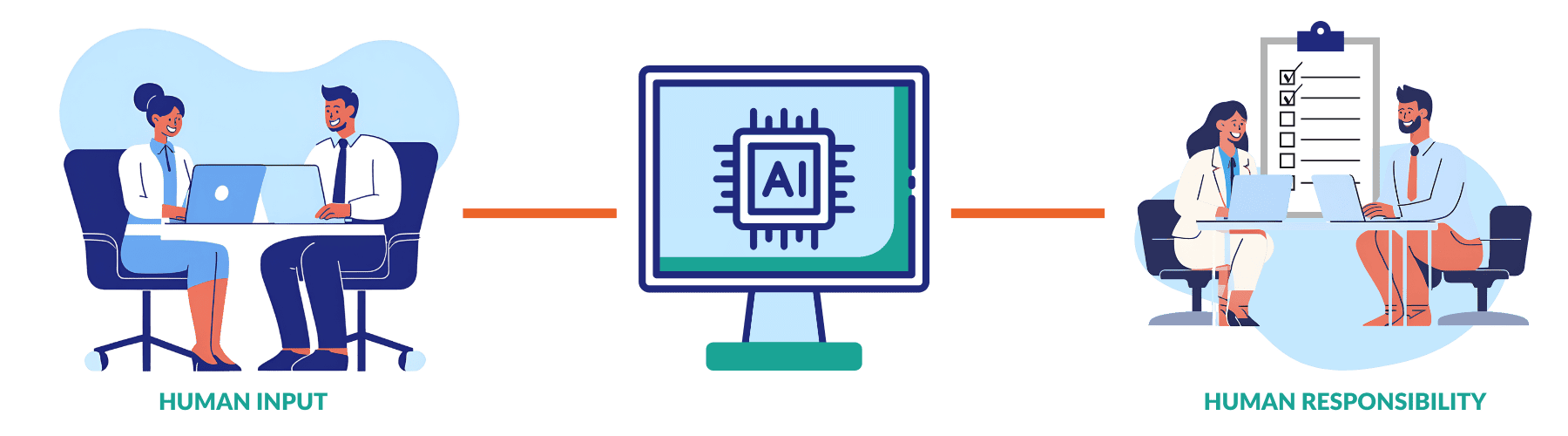
Human Input: Define the purpose and parameters of the AI task. Educators or administrators should clearly outline goals, provide contextual information, and input ethically sourced data to guide the AI system.
Machine Processing: Allow the AI to generate content, analyze data, or provide insights based on the defined task. AI acts as a tool to augment, not replace, human understanding.
Human Review: Evaluate AI for accuracy, relevance, and ethical alignment. Adjust content that does not meet quality or equity standards. Use professional judgment to ensure the final result reflects values and priorities.
AI Learning and Resources
AI Principals: Helping School Leaders Understand, Use, and Lead with AI
- AI: Action Figure Mishele Barnett, Communications & Digital Media Coordinator, AWSP Apr 18, 2025 | At AWSP, we’re always looking for new, fun, and meaningful ways to explore the world of artificial intelligence—and share those discoveries with you!
- AI: A Game-Changer for Students with Disabilities Mishele Barnett, Communications & Digital Media Coordinator, AWSP Jan 7, 2025 | Artificial Intelligence (AI) is transforming education, especially for students with disabilities. A recent Associated Press article highlights how AI tools are helping students like 14-year-old Makenzie Gilkison, who struggled with dyslexia, succeed academically.
- Custom GPTs: Your Secret Weapon for Smarter School Leadership Mishele Barnett, Communications & Digital Media Coordinator, AWSP Dec 11, 2024 | By creating a GPT tailored to your institution’s unique needs, you unlock capabilities that go far beyond those of a regular AI tool. Here’s how you can set it up and what tasks it can accomplish to streamline your workload, foster efficiency, and amplify your school’s impact.